Ocugen Inc. Faces the Biotech Reality: Why OCGN Stock Cannot Escape the Gravity of Regulatory Filings
OCGN
Ocugen Inc. has long captured retail imagination with its ambitious pipeline, but a look behind the curtain of its regulatory disclosures reveals a familiar biotech story written in the dry language of financing agreements. While market enthusiasm often focuses on prospective clinical milestones, the SEC filings from May and June of 2026 paint a picture of a company constantly managing its capital structure to keep the lights on.
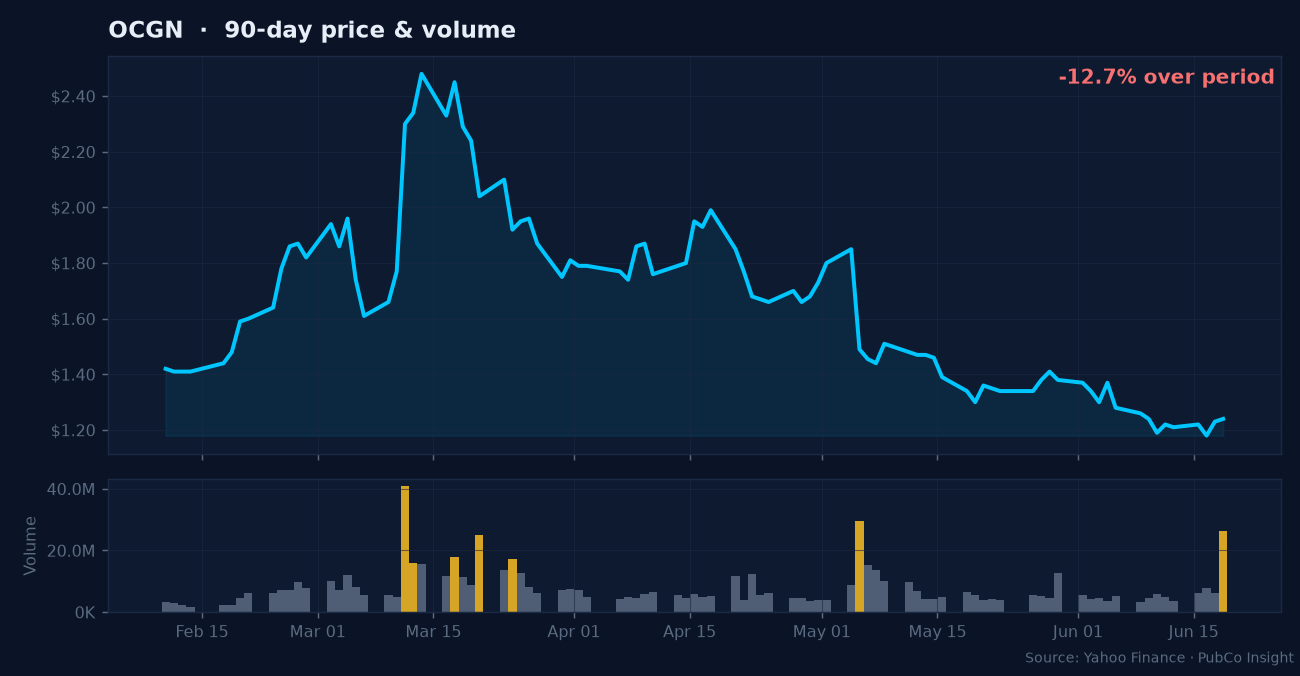
Specifically, the company filed an 8-K on May 7, 2026, detailing a material definitive agreement alongside its earnings release. This filing, which triggered multiple disclosure items including unregistered sales of equity securities and material debt obligations, highlights the structural mechanics that keep OCGN functioning. In biotech, capital is the ultimate oxygen, and these agreements often come with terms that can dilute existing shareholders over time.
The flurry of Form 4 filings in mid-June 2026 further underscores the internal movements at the company. With over 338 million shares outstanding and a market capitalization hovering around 419 million dollars, the sheer volume of equity in circulation means that any new financing, debt conversion, or equity issuance faces a high hurdle to deliver per-share value to retail investors.
When a company frequently utilizes unregistered sales of equity and enters into complex material agreements, it is not a sign of operational ease. It is a sign of a company managing its runway month by month. Investors who focus only on press releases risk missing how these financing structures actually work under the hood, particularly how they impact the total share count and potential dilution.
Understanding OCGN requires looking past the clinical trial hype and focusing on the balance sheet mechanics. The data shows a company deeply reliant on structured agreements to maintain its Nasdaq listing and fund its pipeline. Know what you own, and keep a close eye on the next quarterly filing to see how much of the company you actually still own.
Primary sources (SEC EDGAR)
4 2026-06-17: https://www.sec.gov/Archives/edgar/data/1372299/000162828026043886/xslF345X06/wk-form4_1781727229.xml4 2026-06-15: https://www.sec.gov/Archives/edgar/data/1372299/000110465926074078/xslF345X06/tm2617964-5_4seq1.xml4 2026-06-15: https://www.sec.gov/Archives/edgar/data/1372299/000110465926074076/xslF345X06/tm2617964d4_4seq1.xml4 2026-06-15: https://www.sec.gov/Archives/edgar/data/1372299/000110465926074073/xslF345X06/tm2617964-3_4seq1.xml4 2026-06-15: https://www.sec.gov/Archives/edgar/data/1372299/000110465926074072/xslF345X06/tm2617964-2_4seq1.xml4 2026-06-15: https://www.sec.gov/Archives/edgar/data/1372299/000110465926074064/xslF345X06/tm2617964-1_4seq1.xmlSee the dilution and promotion flags before you see the pitch.
Each week: the micro and small-caps now showing dilution or paid-promotion signals, with the SEC filing behind every flag. No recommendations, no price targets.