Onar Holding Corp (ONAR) Navigates Sector Evolution with Fresh Corporate Filings
ONAR
Onar Holding Corp, trading under the ticker ONAR, is currently navigating an interesting phase of corporate development. Operating within the specialized trade contracting and marketing sectors, the company is working to position itself at the intersection of physical infrastructure services and modern promotional strategies. This dual focus allows the organization to address diverse market demands, leveraging specialized trade expertise while exploring contemporary marketing avenues to drive business acquisition and brand awareness.
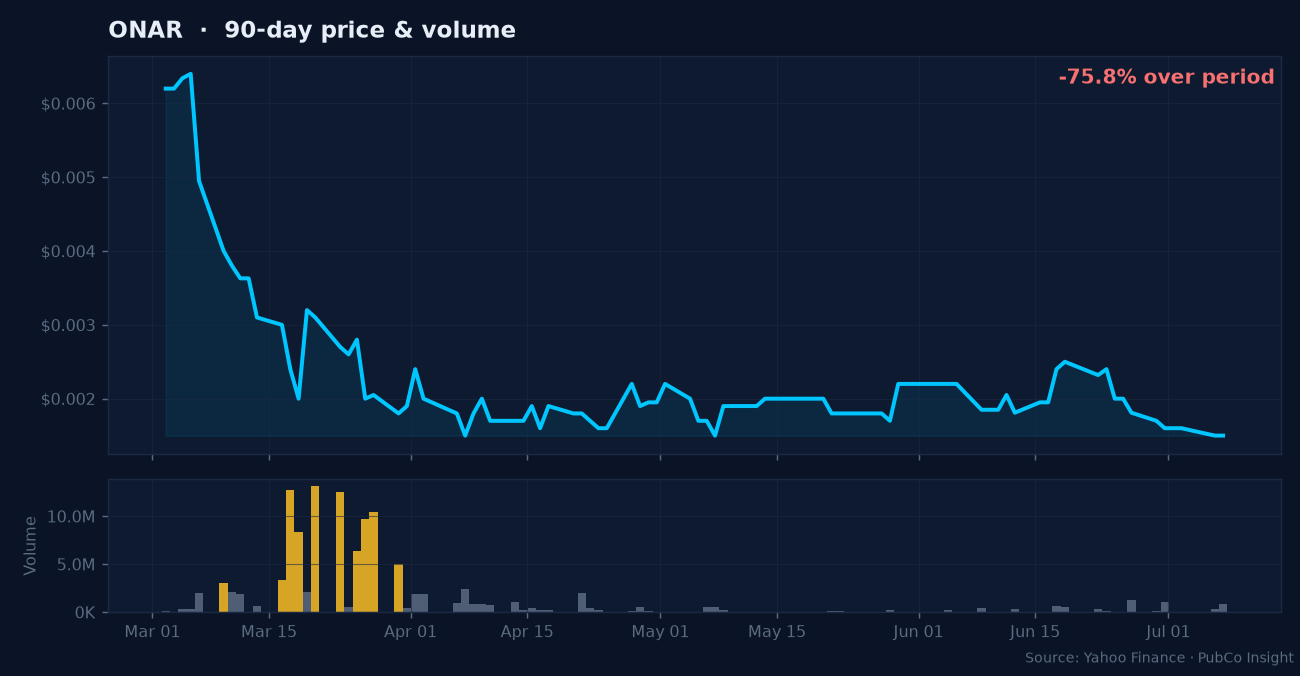
Recent regulatory activity highlights the company's focus on administrative and strategic alignment. Onar Holding Corp filed its annual report on Form 10-K on June 11, 2026, providing the market with updated transparency regarding its operational structure and financial standing. This filing followed a series of corporate updates, including a definitive information statement on Form DEF 14C filed on June 1, 2026, and a preliminary statement in May. These filings collectively indicate a concerted effort by management to streamline corporate governance and prepare the corporate structure for future operational initiatives.
The specialized contracting sector continues to present steady demand as commercial and residential entities seek niche expertise for complex projects. By maintaining its footprint in this space while integrating marketing capabilities, Onar Holding Corp aims to build a more resilient business model. The integration of marketing services can serve as an internal accelerator, helping the contracting arm reach a broader client base while operating as a standalone revenue generator. This hybrid approach represents a creative path toward building long-term shareholder value.
As with many micro-cap enterprises, investors should consider the inherent risks associated with Onar Holding Corp's current growth phase. The company has recently utilized extension filings, such as the Form NT 10-Q in May 2026 and Form NT 10-K in March 2026, which point to the administrative complexities often faced by smaller public entities in meeting reporting timelines. Furthermore, executing a dual-sector strategy requires careful capital allocation, and the company may require additional financing to fully realize its operational goals. Limited trading liquidity on the OTC market also remains a standard consideration for prospective shareholders.
Looking forward, the successful execution of Onar Holding Corp's business plan will depend on management's ability to balance its specialized trade operations with its marketing initiatives. The completion of its recent regulatory filings represents a necessary step in establishing a stable administrative foundation. For observers of the micro-cap space, the company's ongoing efforts to optimize its corporate structure and leverage its dual-sector capabilities make it an interesting case study in corporate adaptation.
Primary sources (SEC EDGAR)
10-K 2026-06-11: https://www.sec.gov/Archives/edgar/data/1682265/000147793226003805/onar_10k.htmDEF 14C 2026-06-01: https://www.sec.gov/Archives/edgar/data/1682265/000147793226003558/onar_def14c.htmNT 10-Q 2026-05-18: https://www.sec.gov/Archives/edgar/data/1682265/000147793226003285/onar_nt10q.htmPRE 14C 2026-05-05: https://www.sec.gov/Archives/edgar/data/1682265/000147793226002768/onar_pre14c.htmEFFECT 2026-04-03: https://www.sec.gov/Archives/edgar/data/1682265/999999999526001079/xslEFFECTX01/primary_doc.xmlNT 10-K 2026-03-31: https://www.sec.gov/Archives/edgar/data/1682265/000147793226001826/onar_nt10k.htmSee the dilution and promotion flags before you see the pitch.
Each week: the micro and small-caps now showing dilution or paid-promotion signals, with the SEC filing behind every flag. No recommendations, no price targets.