SANGAMO THERAPEUTICS, INC (SGMO) Flags Going Concern, Delays 10-Q Filing
SGMO
SANGAMO THERAPEUTICS, INC (SGMO) recently disclosed a going concern uncertainty in an August 28, 2026 8-K filing, just days after notifying the SEC of a delayed Q2 2026 10-Q report on August 17, 2026. This combination of events signals a period of heightened financial scrutiny for the biotech company, which has a market capitalization of under $30 million.
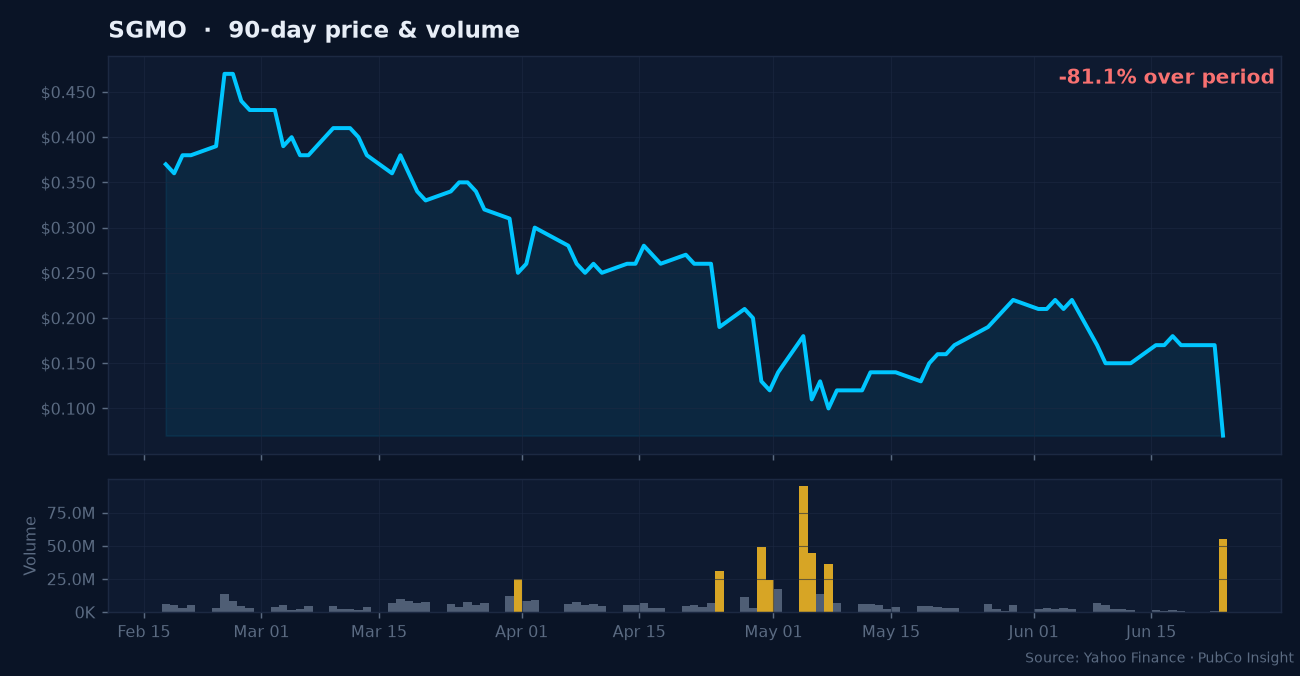
The NT 10-Q filing indicated that SGMO would not be able to file its quarterly report on time, citing the need for additional time to complete its financial statements. While not uncommon, when coupled with a going concern warning, it suggests more than just administrative delays. Investors should understand that a going concern flag means management has determined there is substantial doubt about the company's ability to continue as an ongoing business for at least the next twelve months.
These recent disclosures follow a series of material agreements and corporate restructuring events. An August 28, 2026 8-K details new material agreements, while a September 8, 2026 8-K references an acquisition or disposition of assets. These transactions, alongside a June 23, 2026 8-K that also mentioned material agreements and costs associated with exit or disposal activities, paint a picture of a company undergoing significant operational changes. The details of these changes and their financial implications will be critical for understanding SGMO's path forward, but those details are currently pending the overdue 10-Q.
The delay in filing the 10-Q means shareholders are operating with incomplete and outdated financial information at a time when the company itself is questioning its ability to continue operations. This lack of current data, combined with the explicit going concern warning, introduces considerable uncertainty regarding the company's financial stability and operational trajectory. While the company is actively engaged in new agreements and restructuring, the immediate financial picture remains opaque.
Shareholders should recognize that delays in financial reporting, especially when accompanied by a going concern qualification, are serious indicators of potential financial distress. The market for micro-cap biotech companies can be volatile, and a lack of current, audited financial statements limits the ability to make informed decisions. Knowing what you own means understanding the full scope of financial and operational risks, which in this case, remain largely unquantified due to the filing delay.
Primary sources (SEC EDGAR)
8-K 2026-09-08: https://www.sec.gov/Archives/edgar/data/1001233/000110465926105905/tm2624942d1_8k.htm8-K 2026-08-28: https://www.sec.gov/Archives/edgar/data/1001233/000119312526374328/d116527d8k.htmNT 10-Q 2026-08-17: https://www.sec.gov/Archives/edgar/data/1001233/000119312526354282/d168229dnt10q.htmSCHEDULE 13G/A 2026-08-14: https://www.sec.gov/Archives/edgar/data/1001233/000117266126003615/xslSCHEDULE_13G_X02/primary_doc.xml8-K 2026-08-13: https://www.sec.gov/Archives/edgar/data/1001233/000119312526347524/d125617d8k.htm8-K 2026-08-12: https://www.sec.gov/Archives/edgar/data/1001233/000119312526346796/d21956d8k.htmSee the dilution and promotion flags before you see the pitch.
Each week: the micro and small-caps now showing dilution or paid-promotion signals, with the SEC filing behind every flag. No recommendations, no price targets.