SANGAMO THERAPEUTICS, INC (SGMO): Delisting and Restructuring Mark a Slide to the OTC
SGMO
When a pioneering genomic medicine developer finds itself trading on the OTC markets with a 48 million dollar market capitalization, the transition is rarely subtle. For SANGAMO THERAPEUTICS, INC, the paper trail on EDGAR marks a clear shift from major-exchange biotechnology contender to an unglamorous OTC existence, punctuated by a Form 25-NSE delisting filing in October 2026.
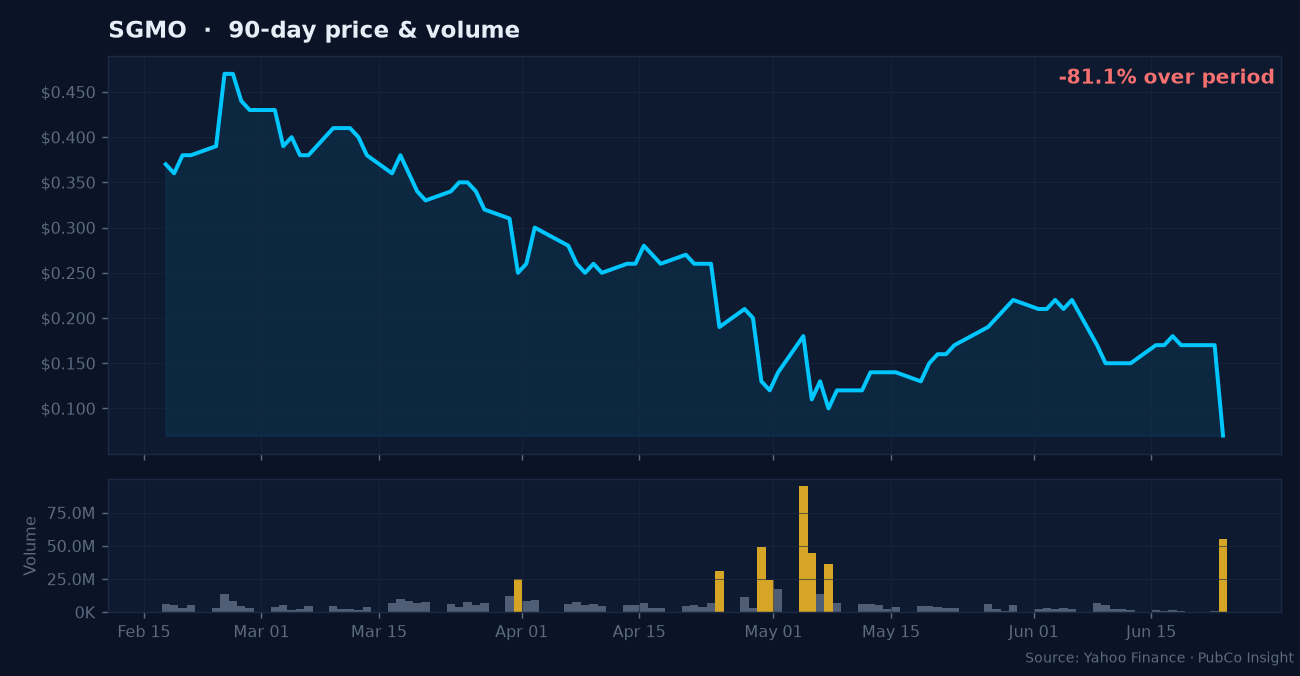
A close look at the recent Form 8-K submissions reveals the structural changes reshaping the company. Across late August and September 2026, the company logged multiple disclosures citing Item 1.03 for bankruptcy or receivership, alongside Item 2.01 covering asset dispositions and Item 1.01 material agreements. These filings confirm that SANGAMO THERAPEUTICS, INC has undergone significant restructuring and asset offloading rather than standard operational growth.
For retail investors, the combination of court-supervised proceedings or formal reorganization steps alongside disposals alters the entire capital structure equation. With 414.29 million shares outstanding, equity holders sitting at the bottom of the priority ladder face severe structural overhangs. Investors monitoring how regulatory shifts and secondary trading venues affect access can track delinquency and trading access flags to understand the mechanics of post-delisting liquidity.
While subsequent filings in mid-to-late October 2026 consisted of Regulation FD disclosures under Item 7.01, press releases do not undo the reality etched into previous restructuring items. Understanding the true residual value of an enterprise post-delisting requires reading past the headline biology and focusing squarely on which assets remain after the Item 2.01 transactions have settled.
Primary sources (SEC EDGAR)
8-K 2026-10-27: https://www.sec.gov/Archives/edgar/data/1001233/000119312526434171/d179328d8k.htm8-K 2026-10-16: https://www.sec.gov/Archives/edgar/data/1001233/000119312526423054/d453907d8k.htm25-NSE 2026-10-07: https://www.sec.gov/Archives/edgar/data/1001233/000135445726000959/xslF25X02/primary_doc.xml8-K 2026-09-21: https://www.sec.gov/Archives/edgar/data/1001233/000119312526396644/d178611d8k.htm8-K 2026-09-08: https://www.sec.gov/Archives/edgar/data/1001233/000110465926105905/tm2624942d1_8k.htm8-K 2026-08-28: https://www.sec.gov/Archives/edgar/data/1001233/000119312526374328/d116527d8k.htmSee the dilution and promotion flags before you see the pitch.
Each week: the micro and small-caps now showing dilution or paid-promotion signals, with the SEC filing behind every flag. No recommendations, no price targets.