Workhorse Group Inc. (WKHS): Heavy Deal Flow and Equity Restructuring on a Sub-$30M Valuation
WKHS
Workhorse Group Inc. once traded on grand narratives of commercial electric vehicle domination, but its recent EDGAR footprint reveals a business operating under a completely different reality. With a market capitalization whittled down to roughly $28.41 million across 10.93 million common shares, the margin for error has narrowed from highway width to a single painted line.
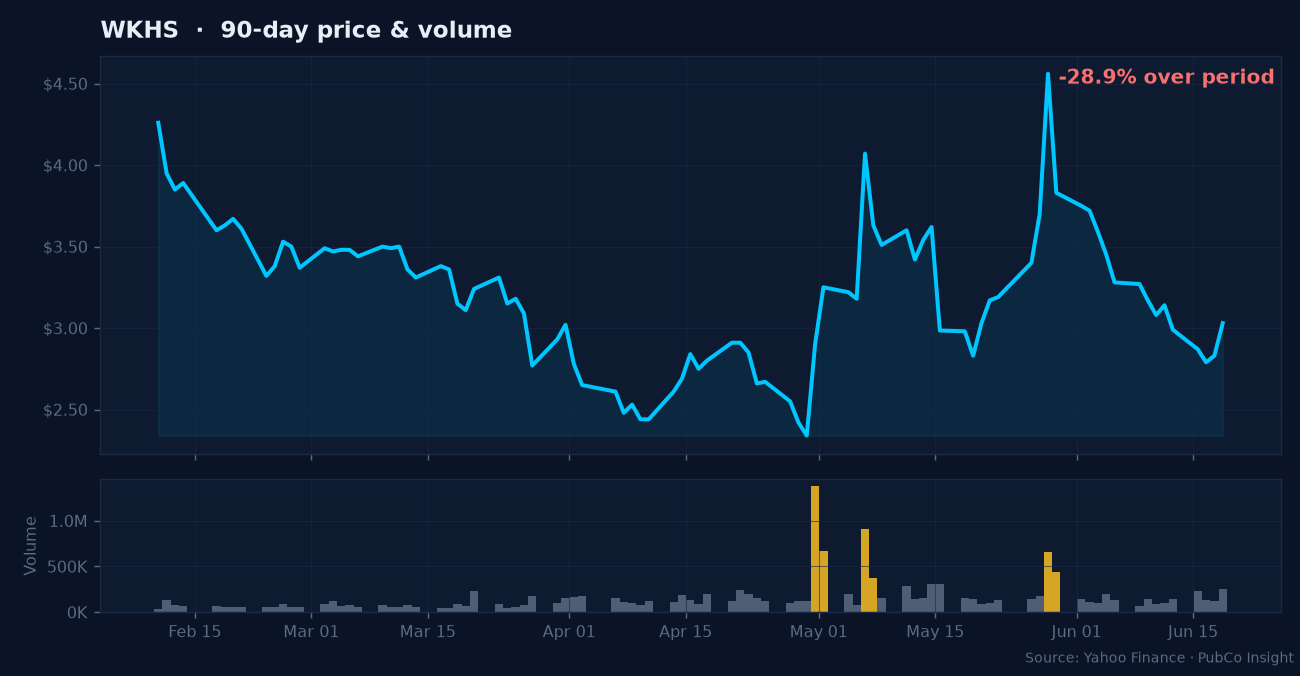
The filings over the second half of 2026 tell the unglamorous mechanics of balance sheet survival. On August 12, 2026, Workhorse Group Inc. filed an 8-K under Items 1.01, 2.03, and 3.02, documenting entry into a material agreement alongside the creation of direct financial obligations and unregistered sales of equity. For equity holders who monitor dilution risk, Item 3.02 is always the tell: when private paper enters the capital structure, existing shares inevitably surrender ownership percentage.
That transaction was immediately followed by a 10-Q and earnings disclosure on August 13, 2026, underscoring the tight relationship between reporting cycles and capital arrangements. Within weeks, on August 25, Schedule 13D/A and Form 4 filings hit the wire, reflecting shifting stakes among major holders. By late September, an 8-K citing Item 5.02 signaled departures or appointments at the leadership level, demonstrating that the organizational chart is changing in tandem with the share registry.
The dealmaking did not pause there. On October 29, 2026, the company submitted another multi-item 8-K disclosing further material agreements under Item 1.01 and Item 8.01. When a micro-cap vehicle manufacturer logs two separate Item 1.01 agreements within ten weeks, it is actively restructuring obligations or chasing fresh commercial terms simply to preserve operational runway.
For retail market participants evaluating WKHS, the takeaway is mechanical rather than emotional. The company remains an operational commercial EV entity, but the capital structure is carrying the weight of sequential bilateral agreements and private placements. In micro-cap turnarounds, understanding the terms that dictate share counts matters far more than conceptual market opportunity.
Primary sources (SEC EDGAR)
8-K 2026-10-29: https://www.sec.gov/Archives/edgar/data/1425287/000162828026068250/wkhs-20261028.htm144 2026-10-09: https://www.sec.gov/Archives/edgar/data/1425287/000195917326007329/xsl144X01/primary_doc.xml8-K 2026-09-28: https://www.sec.gov/Archives/edgar/data/1425287/000162828026063719/wkhs-20260922.htm4 2026-08-25: https://www.sec.gov/Archives/edgar/data/1425287/000209739026000008/xslF345X06/wk-form4_1787693344.xmlSCHEDULE 13D/A 2026-08-25: https://www.sec.gov/Archives/edgar/data/1425287/000209739026000006/xslSCHEDULE_13D_X02/primary_doc.xml10-Q 2026-08-13: https://www.sec.gov/Archives/edgar/data/1425287/000162828026056708/wkhs-20260630.htmSee the dilution and promotion flags before you see the pitch.
Each week: the micro and small-caps now showing dilution or paid-promotion signals, with the SEC filing behind every flag. No recommendations, no price targets.