Workhorse Group Inc. (WKHS): Fresh Material Agreements Arrive at a Micro-Cap Valuation
WKHS
When an electric vehicle maker is valued at just 32.24 million dollars on a float of 10.93 million shares, every new entry on the SEC docket carries outsized weight. Workhorse Group Inc. entered late 2026 with a flurry of regulatory paperwork, reminding retail investors that capital structure mechanics matter far more than past hype in the commercial delivery sector.
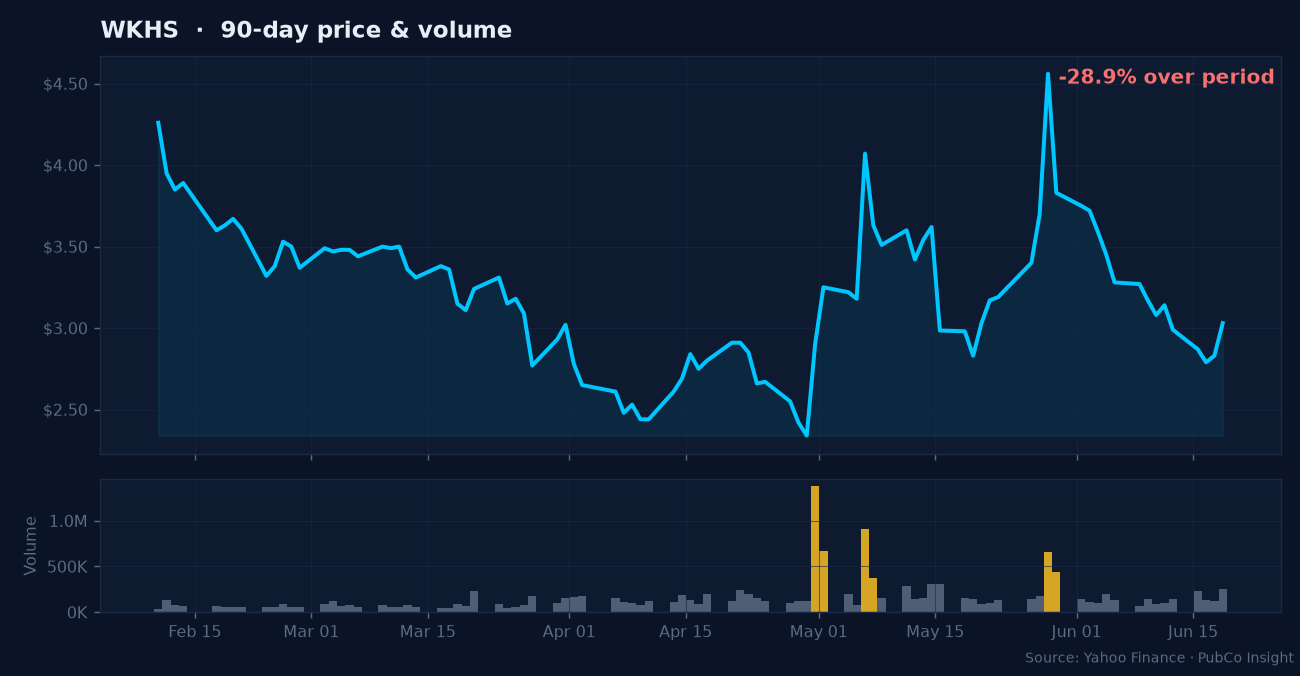
The filings tell the real story of operational reality. On October 29, 2026, Workhorse Group Inc. filed an 8-K under Items 1.01, 7.01, and 8.01, disclosing entry into a material definitive agreement alongside Regulation FD disclosures. A few days later, on November 2, 2026, another 8-K arrived, triggering Item 1.01 and Item 2.03, which covers the creation of direct financial obligations. For any micro-cap manufacturer, the introduction of binding financial agreements often signals structural capital demands that existing equity holders must bear.
These filings follow governance adjustments, including an Item 5.02 departure or appointment disclosed on September 28, 2026, as well as insider tracking through Form 144 and Schedule 13D/A filings late in the summer. When balance sheets run lean and a company signs direct financial obligations, investors must closely track the fine print around conversion prices, covenants, and priority ranking over ordinary shares through our dilution risk tools.
The structural setup here is straightforward. Workhorse Group Inc. remains listed on the Nasdaq, but its compressed equity base makes each new financing arrangement significantly more impactful to common ownership. Whether these material agreements fund ongoing commercial production or bridge short-term liquidity, the terms dictate where common equity sits in the capital stack.
For micro-cap traders watching WKHS, hope is not an operational strategy. Reading the Item 1.01 and Item 2.03 disclosures directly from the source is the only reliable way to know what you own before the consequences of new commitments reach the trading screen.
Primary sources (SEC EDGAR)
8-K 2026-11-02: https://www.sec.gov/Archives/edgar/data/1425287/000162828026068874/wkhs-20261027.htm8-K 2026-10-29: https://www.sec.gov/Archives/edgar/data/1425287/000162828026068250/wkhs-20261028.htm144 2026-10-09: https://www.sec.gov/Archives/edgar/data/1425287/000195917326007329/xsl144X01/primary_doc.xml8-K 2026-09-28: https://www.sec.gov/Archives/edgar/data/1425287/000162828026063719/wkhs-20260922.htm4 2026-08-25: https://www.sec.gov/Archives/edgar/data/1425287/000209739026000008/xslF345X06/wk-form4_1787693344.xmlSCHEDULE 13D/A 2026-08-25: https://www.sec.gov/Archives/edgar/data/1425287/000209739026000006/xslSCHEDULE_13D_X02/primary_doc.xmlSee the dilution and promotion flags before you see the pitch.
Each week: the micro and small-caps now showing dilution or paid-promotion signals, with the SEC filing behind every flag. No recommendations, no price targets.