Canopy Growth Corp (CGC): Heavy Proxy Activity Meets a Stretched Share Count
CGC
Canopy Growth Corp commands a massive footprint in market discussions, but the regulatory docket tells a more procedural, grinding story. With a market capitalization around 573.69 million dollars spread across 449.28 million shares outstanding, the capital structure carries the weight of years of restructuring. When a company's share count reaches this scale, every corporate ballot initiative matters, because moving the needle on per-share metrics requires heavy lifting rather than optimism.
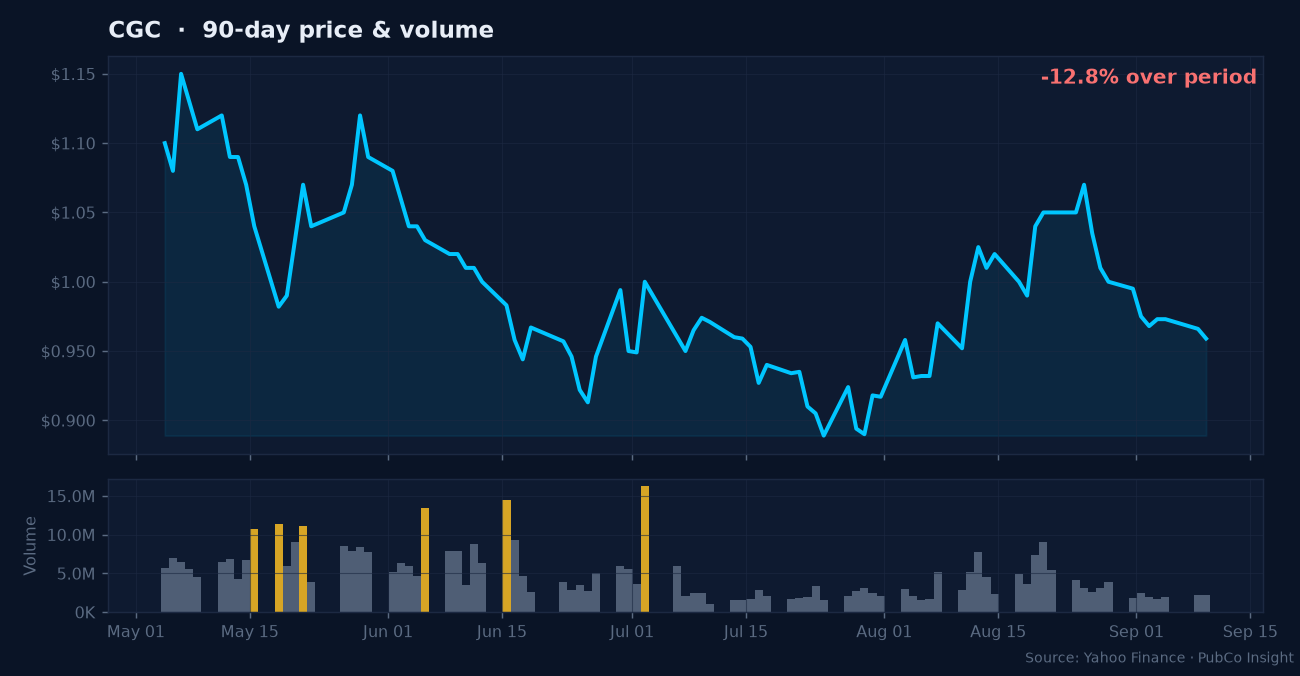
A look through the recent SEC filings shows a flurry of DEFA14A materials alongside an annual report and subsequent Form 4 insider reports in August. DEFA14A filings are additional proxy soliciting materials, signaling an active campaign to ensure shareholder participation on key ballot items. When management expends resources drumming up proxy votes, it usually points to critical governance approvals, incentive pool refreshes, or structural authorizations that require broad quorum and assent from a fragmented retail base.
This persistent proxy outreach coincides with active retail buzz, tracked across multiple news sources even as the underlying mechanics remain tied to operational execution. Investors caught up in broader sector sentiment often overlook how governance actions lay the groundwork for future capital moves. Evaluating that ongoing exposure requires understanding structural mechanics through tools like our market attention tracker, especially when narrative outpaces the filings.
The two Form 4 filings logged in late August reflect routine insider reporting, but in a company where hundreds of millions of shares are already distributed, equity-based compensation and insider transactions remain sensitive territory for public holders. The math of a 449.28 million share count means that incremental changes to compensation plans or share reserve pools can gradually mute per-share recovery, even if high-level operations improve.
Canopy Growth Corp remains an active fixture on the Nasdaq, but navigating it demands separating sentiment from the paperwork. For shareholders, watching how the proxy votes settle is far more instructive than following market chatter. A firm with this many shares out cannot simply trade its way out of structural dilution without strict discipline on governance and capital allocation.
Primary sources (SEC EDGAR)
4 2026-08-25: https://www.sec.gov/Archives/edgar/data/1737927/000110465926100926/xslF345X06/tm2624025-2_4seq1.xml4 2026-08-25: https://www.sec.gov/Archives/edgar/data/1737927/000110465926100924/xslF345X06/tm2624025-1_4seq1.xmlDEFA14A 2026-08-17: https://www.sec.gov/Archives/edgar/data/1737927/000110465926097947/tm2620644d10_defa14a.htmDEFA14A 2026-08-14: https://www.sec.gov/Archives/edgar/data/1737927/000110465926097312/tm2620644d9_defa14a.htmDEFA14A 2026-08-07: https://www.sec.gov/Archives/edgar/data/1737927/000110465926092764/tm2620644d6_defa14a.htmARS 2026-08-07: https://www.sec.gov/Archives/edgar/data/1737927/000110465926092762/tm2620644d5_ars.pdfSee the dilution and promotion flags before you see the pitch.
Each week: the micro and small-caps now showing dilution or paid-promotion signals, with the SEC filing behind every flag. No recommendations, no price targets.