Evaluating the Risk Profile of Workhorse Group Inc. (WKHS) Amid Recent SEC Filings
WKHS
Workhorse Group Inc. (WKHS), an electric vehicle manufacturer in the motor vehicles and passenger car bodies sector, has recently updated its regulatory disclosures. With a market capitalization of approximately 41.72 million dollars and 10.89 million shares outstanding, the Nasdaq-listed company has a relatively small footprint that subjects it to the volatility and operational challenges typical of micro-cap entities in the capital-intensive electric vehicle space.
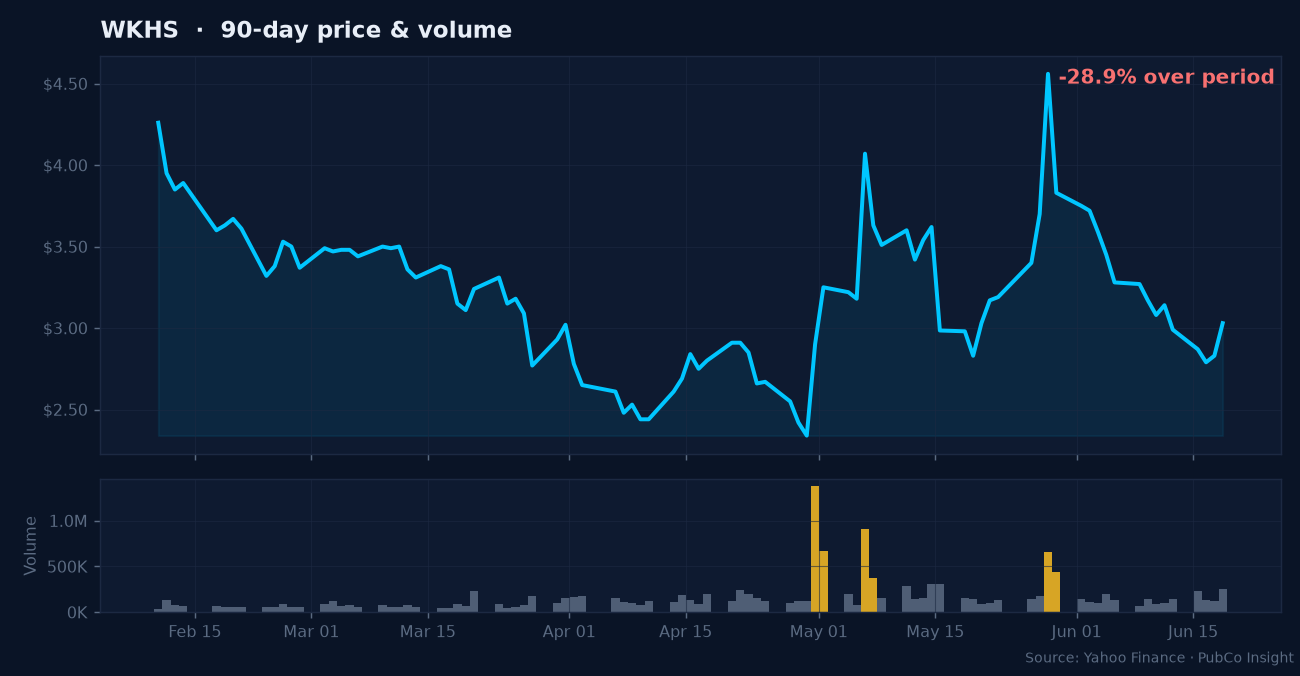
On May 14, 2026, Workhorse filed its quarterly report on Form 10-Q, alongside an 8-K filing under Item 2.02 and Item 9.01 to disclose its quarterly financial results. These filings provide retail investors with critical updates on the company's balance sheet, cash burn rate, and ongoing operational viability. For micro-cap companies in the electric vehicle sector, monitoring cash reserves and working capital is vital, as these firms often require continuous capital injections to sustain manufacturing operations and product development.
Further regulatory activity includes a series of filings on May 20, 2026, which featured an Annual Report to Shareholders (ARS), a definitive proxy statement on Form DEF 14A, and additional proxy materials on Form DEFA14A. These documents outline the governance structure of the company and detail the upcoming shareholder votes. Investors should review these proxy materials closely, as they frequently contain proposals regarding executive compensation, board elections, and potential authorizations for share issuance, which can lead to equity dilution.
Prior to these filings, the company also submitted an 8-K on April 27, 2026, detailing a material agreement under Item 1.01 and Item 2.03. Such agreements often involve debt obligations or financing arrangements that can impact the company's capital structure and future cash flows. Additionally, a Schedule 13G/A filed on May 15, 2026, indicates recent shifts in beneficial ownership by major shareholders, which can influence voting outcomes and market sentiment. Retail investors should weigh these governance and financing disclosures carefully when assessing the long-term risk profile of Workhorse.
Primary sources (SEC EDGAR)
ARS 2026-05-20: https://www.sec.gov/Archives/edgar/data/1425287/000114036126022249/ny20071753x3_ars.pdfDEFA14A 2026-05-20: https://www.sec.gov/Archives/edgar/data/1425287/000114036126022248/ny20071753x2_defa14a.htmDEF 14A 2026-05-20: https://www.sec.gov/Archives/edgar/data/1425287/000114036126022246/ny20071753x1_def14a.htmSCHEDULE 13G/A 2026-05-15: https://www.sec.gov/Archives/edgar/data/1425287/000194797526000015/xslSCHEDULE_13G_X02/primary_doc.xml10-Q 2026-05-14: https://www.sec.gov/Archives/edgar/data/1425287/000162828026035109/wkhs-20260331.htm8-K 2026-05-14: https://www.sec.gov/Archives/edgar/data/1425287/000162828026035102/wkhs-20260514.htmSee the dilution and promotion flags before you see the pitch.
Each week: the micro and small-caps now showing dilution or paid-promotion signals, with the SEC filing behind every flag. No recommendations, no price targets.