Workhorse Group (WKHS) Navigates Debt Amidst EV Market Realities
WKHS
Workhorse Group Inc. (WKHS), an electric vehicle manufacturer, recently disclosed a secured financing agreement, a common occurrence for companies operating in capital-intensive sectors like EVs. An 8-K filed on June 17, 2026, detailed the entry into a Secured Promissory Note and a Security Agreement, signaling ongoing efforts to secure funding for operations. For retail investors watching WKHS, these filings are not just procedural updates; they are a window into how the company is managing its liquidity in a competitive and rapidly evolving market.
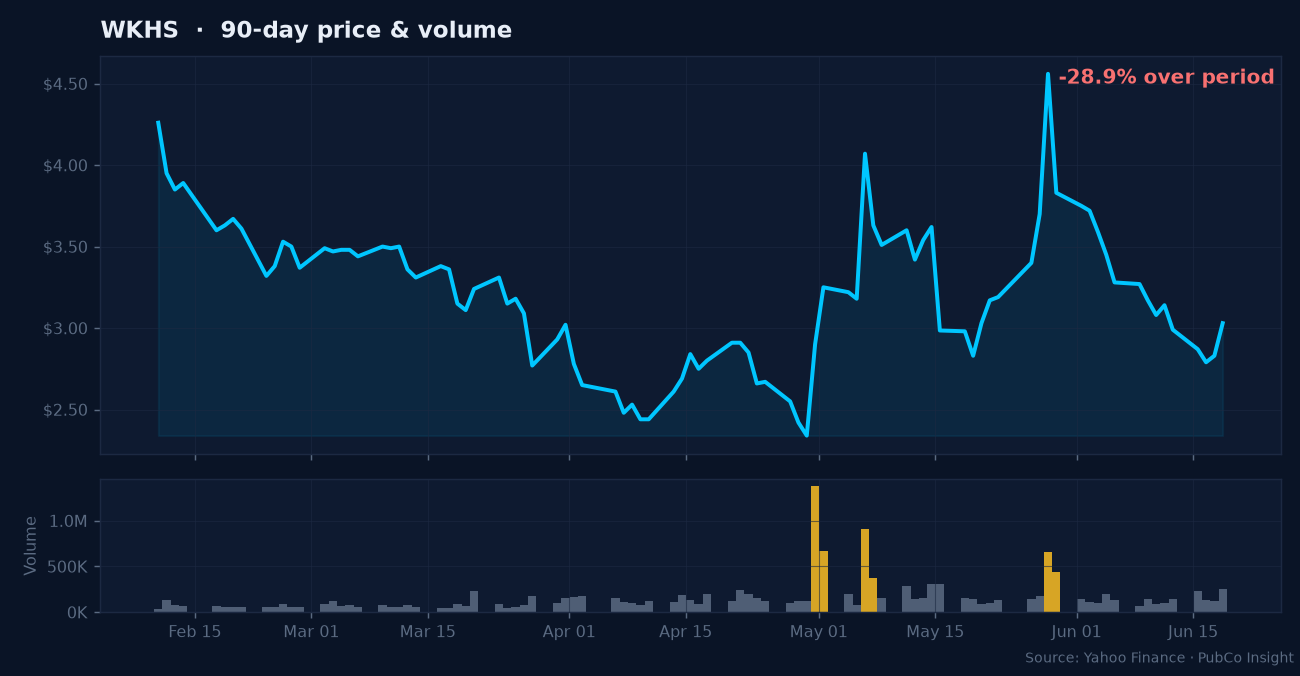
The June 17, 2026, 8-K, specifically under Item 1.01 and 2.03, points to the company incurring new debt. While the specifics of the new note are contained within the filing, the mere existence of such an agreement, following previous financing rounds, underscores a persistent need for capital. This is a recurring theme for many early-stage EV companies that are long on ambition and short on consistent free cash flow. Investors should recognize that new debt, particularly secured debt, can impact a company's financial flexibility and future borrowing capacity.
Looking back at the May 14, 2026, 10-Q filing for the period ending March 31, 2026, provides the broader financial context. This quarterly report is where the unglamorous reality of operations, including cash burn and working capital, is laid bare. Without specific numbers from the 10-Q in the provided data, the general principle holds: repeated financings, whether through debt or equity, often reflect a company's struggle to achieve self-sustaining profitability. The 10-Q would offer details on Workhorse's current assets, liabilities, and, crucially, its cash flow from operations, which are essential for assessing its financial runway.
The company's market capitalization, sitting at approximately $30 million with 10.89 million shares outstanding, places it firmly in micro-cap territory. In this segment of the market, even relatively small capital infusions can have a noticeable impact, and the cost of capital can be higher. Dilution risk, while not explicitly detailed in the provided data points as an immediate S-1 or 424B filing, is an ever-present consideration for micro-cap companies that frequently rely on equity raises to fund operations. The DEF 14A filings from May 20, 2026, indicate an upcoming shareholder meeting, which often includes proposals related to share authorizations, a precursor to potential future equity financings.
For investors, the takeaway is straightforward: Workhorse Group is actively managing its capital structure in a challenging environment. The June 8-K is a data point in a longer narrative of capital raising. Understanding the implications of these financings requires a diligent review of the underlying financial statements, particularly the latest 10-Q, to assess the company's burn rate and overall financial health. Know what you own, and in the micro-cap space, that means understanding how the company funds its operations.
Primary sources (SEC EDGAR)
8-K 2026-06-17: https://www.sec.gov/Archives/edgar/data/1425287/000162828026043868/wkhs-20260616.htmARS 2026-05-20: https://www.sec.gov/Archives/edgar/data/1425287/000114036126022249/ny20071753x3_ars.pdfDEFA14A 2026-05-20: https://www.sec.gov/Archives/edgar/data/1425287/000114036126022248/ny20071753x2_defa14a.htmDEF 14A 2026-05-20: https://www.sec.gov/Archives/edgar/data/1425287/000114036126022246/ny20071753x1_def14a.htmSCHEDULE 13G/A 2026-05-15: https://www.sec.gov/Archives/edgar/data/1425287/000194797526000015/xslSCHEDULE_13G_X02/primary_doc.xml10-Q 2026-05-14: https://www.sec.gov/Archives/edgar/data/1425287/000162828026035109/wkhs-20260331.htmSee the dilution and promotion flags before you see the pitch.
Each week: the micro and small-caps now showing dilution or paid-promotion signals, with the SEC filing behind every flag. No recommendations, no price targets.