Workhorse Group Inc. Faces a Tightening Financial Runway as WKHS Leans on Structured Debt
WKHS
While electric vehicle developers frequently promise a smooth transition to high volume manufacturing, the quarterly filings for Workhorse Group Inc. tell a much more demanding financial story. The company, trading under ticker WKHS, is operating on a highly constrained runway where survival is increasingly measured by structured financing agreements rather than commercial vehicle deliveries. For retail investors looking past the green energy narrative, the real mechanics of the business are laid bare in the SEC filings.
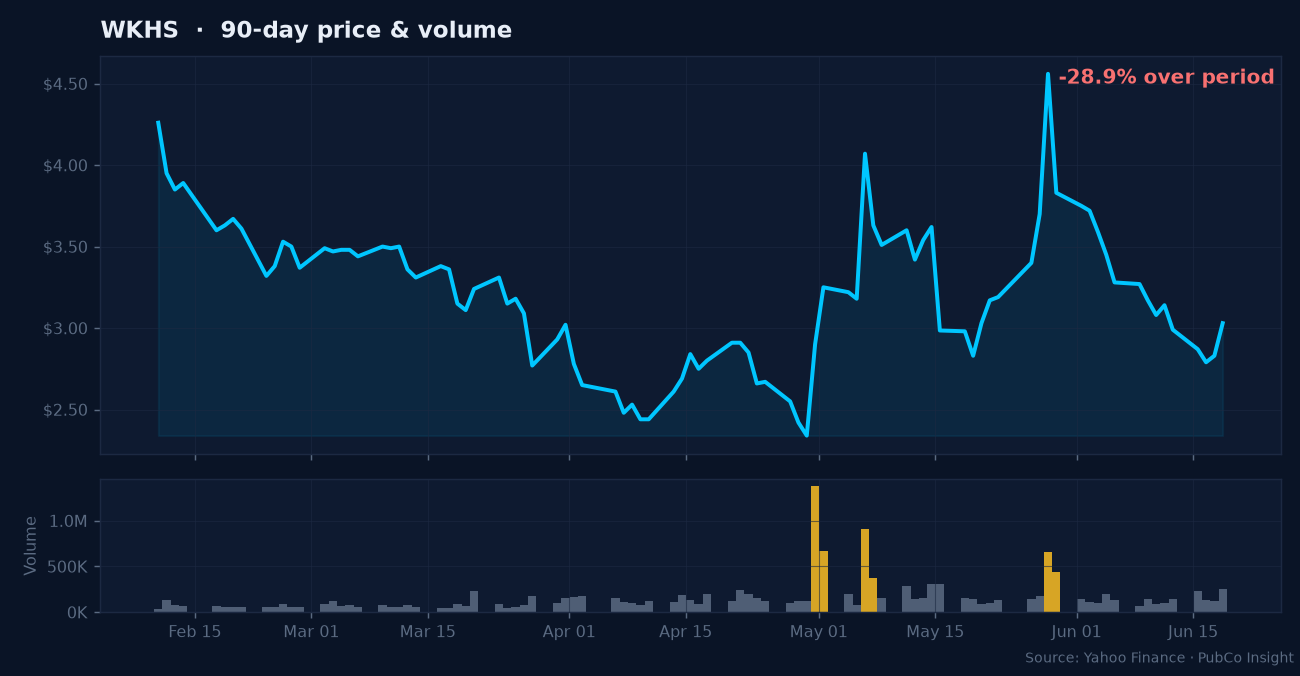
A look at the June 17, 2026 Form 8-K reveals the immediate pressure on the balance sheet. Workhorse Group Inc. entered into a material definitive agreement under Item 1.01 and Item 2.03, signaling the creation of direct financial obligations. These structured debt agreements are often the last line of defense for capital-intensive micro-caps, providing short-term cash flow at the expense of restrictive covenants and potential equity dilution down the road.
The company’s May 14, 2026 Form 10-Q filing reinforces this reality. When operational cash burn outpaces commercial revenue, the gap must be bridged by external funding. For WKHS, this has historically meant relying on dilutive instruments. The presence of recent proxy materials, including the DEF 14A filed on May 20, 2026, indicates that management must continuously seek shareholder approval for corporate actions that often pave the way for additional share authorization and capital restructuring.
Operating in the competitive commercial EV space requires massive capital expenditure, yet Workhorse Group Inc. currently carries a modest market capitalization of approximately 30.39 million dollars. With only 10.89 million shares outstanding, any significant new equity issuance to fund operations or satisfy debt agreements will exert substantial downward pressure on existing shareholders. The financing structures revealed in the recent 8-K highlight how quickly debt can convert into dilutive equity when cash is scarce.
Evaluating a company like WKHS requires looking past the product prototypes and focusing directly on the capital structure. When a business relies on recurring debt agreements and frequent proxy solicitations to keep the lights on, the risk of equity dilution becomes a structural feature rather than a temporary hurdle. Before assuming the operational turn is just around the corner, investors should carefully weigh the ongoing cost of keeping this balance sheet afloat.
Primary sources (SEC EDGAR)
8-K 2026-06-17: https://www.sec.gov/Archives/edgar/data/1425287/000162828026043868/wkhs-20260616.htmARS 2026-05-20: https://www.sec.gov/Archives/edgar/data/1425287/000114036126022249/ny20071753x3_ars.pdfDEFA14A 2026-05-20: https://www.sec.gov/Archives/edgar/data/1425287/000114036126022248/ny20071753x2_defa14a.htmDEF 14A 2026-05-20: https://www.sec.gov/Archives/edgar/data/1425287/000114036126022246/ny20071753x1_def14a.htmSCHEDULE 13G/A 2026-05-15: https://www.sec.gov/Archives/edgar/data/1425287/000194797526000015/xslSCHEDULE_13G_X02/primary_doc.xml10-Q 2026-05-14: https://www.sec.gov/Archives/edgar/data/1425287/000162828026035109/wkhs-20260331.htmSee the dilution and promotion flags before you see the pitch.
Each week: the micro and small-caps now showing dilution or paid-promotion signals, with the SEC filing behind every flag. No recommendations, no price targets.