Workhorse Group Inc. Shuffles Leadership While Debt and Dilution Risks Continue to Mount for WKHS
WKHS
While electric vehicle enthusiasts focus on production promises, the regulatory filings for Workhorse Group Inc. (WKHS) tell a story of rapid executive changes and persistent balance sheet pressure. A flurry of mid-July filings, including multiple Form 3s and an 8-K on July 13, 2026, confirmed yet another round of leadership transitions. Swapping names in the C-suite is a time-honored corporate tradition, but it rarely solves the underlying math of a capital-intensive business running low on runway.
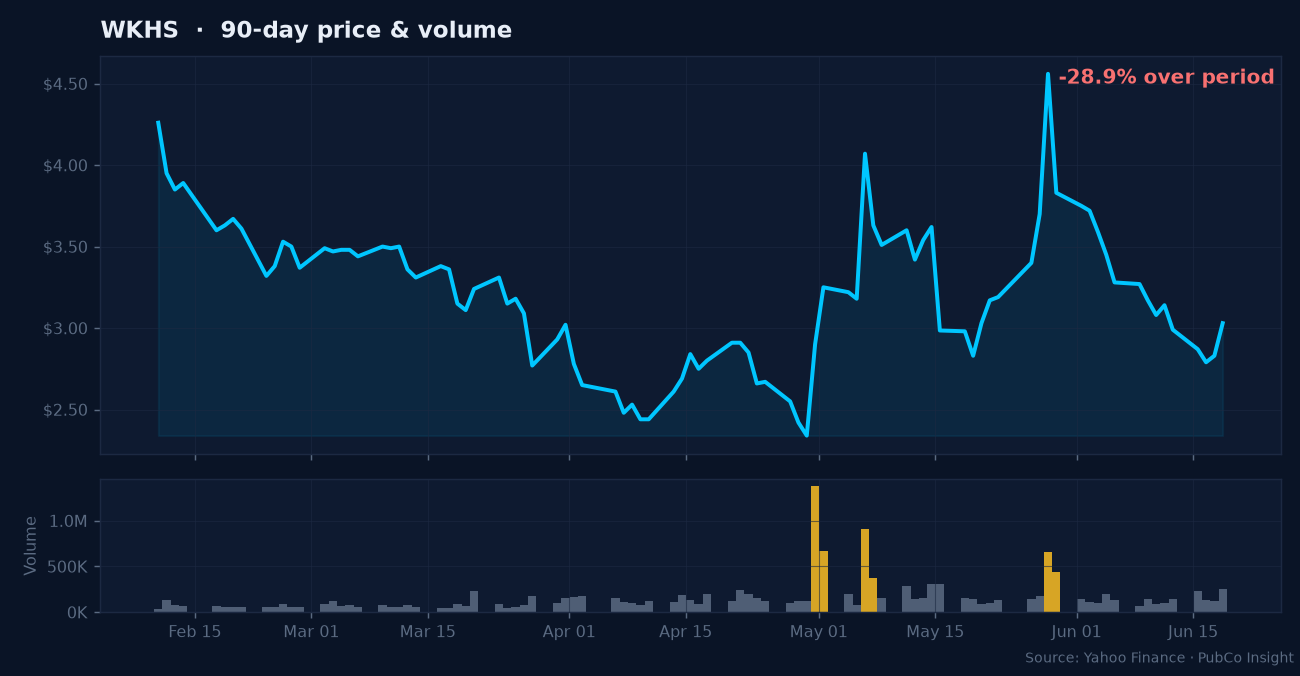
The real tension for Workhorse Group Inc. lies in how the company funds its daily operations. On June 17, 2026, the company entered into a material definitive agreement and incurred new direct financial obligations, according to its Form 8-K. This filing highlights the ongoing reliance on structured debt and financing arrangements to keep the lights on. For retail investors, these recurring debt agreements are a loud signal that cash from actual vehicle sales remains insufficient to cover the burn rate.
Every new debt agreement carries the implicit or explicit threat of future equity issuance to satisfy creditors. With a modest market capitalization of just over 30 million dollars, any significant debt conversion or dilutive funding round can severely erode the value of existing shares. Investors can track these structural financing pressures and their impact on share counts by monitoring dilution risk metrics, which reflect how quickly a micro-cap firm is printing new equity to survive.
Furthermore, the company's annual meeting results filed on June 30, 2026, show a capital structure under constant revision. When a company must repeatedly ask shareholders to approve administrative and structural changes, it is often preparing the ground for the next capital raise. The frequent use of Form 8-K filings to report material agreements and debt obligations over the spring and summer of 2026 underscores that Workhorse Group Inc. is operating on a tight financial leash.
Ultimately, executive shuffles and board seat rotations are merely side shows to the main event, which is the balance sheet. Until the company can generate positive cash flow from its motor vehicles, it remains at the mercy of its lenders and the dilutive mechanics of the public markets. Know what you own, and do not let executive-suite musical chairs distract you from the hard numbers in the quarterly reports.
Primary sources (SEC EDGAR)
3 2026-07-15: https://www.sec.gov/Archives/edgar/data/1425287/000214231326000001/xslF345X06/wk-form3_1784149583.xml3 2026-07-15: https://www.sec.gov/Archives/edgar/data/1425287/000171490826000005/xslF345X06/wk-form3_1784149694.xml8-K 2026-07-13: https://www.sec.gov/Archives/edgar/data/1425287/000162828026048051/wkhs-20260713.htmSD 2026-07-02: https://www.sec.gov/Archives/edgar/data/1425287/000162828026046863/formsd-conflictmineralsrep.htm8-K 2026-06-30: https://www.sec.gov/Archives/edgar/data/1425287/000162828026046224/wkhs-20260629.htm8-K 2026-06-17: https://www.sec.gov/Archives/edgar/data/1425287/000162828026043868/wkhs-20260616.htmSee the dilution and promotion flags before you see the pitch.
Each week: the micro and small-caps now showing dilution or paid-promotion signals, with the SEC filing behind every flag. No recommendations, no price targets.