WKHS Turns to Private Placements as Cash Realities Reshape the Capital Structure
WKHS
Workhorse Group Inc. spent years pitched as a centerpiece of the commercial electric fleet transition, but the filings tell a much more pedestrian story about liquidity management. With a market capitalization lingering near 34.53 million dollars and just 10.89 million shares outstanding, the company is operating in a bracket where balance-sheet maintenance overshadows production headlines. For retail investors watching WKHS, the real story is found in the sequence of current reports dropped into Edgar rather than the aspirational corporate presentations.
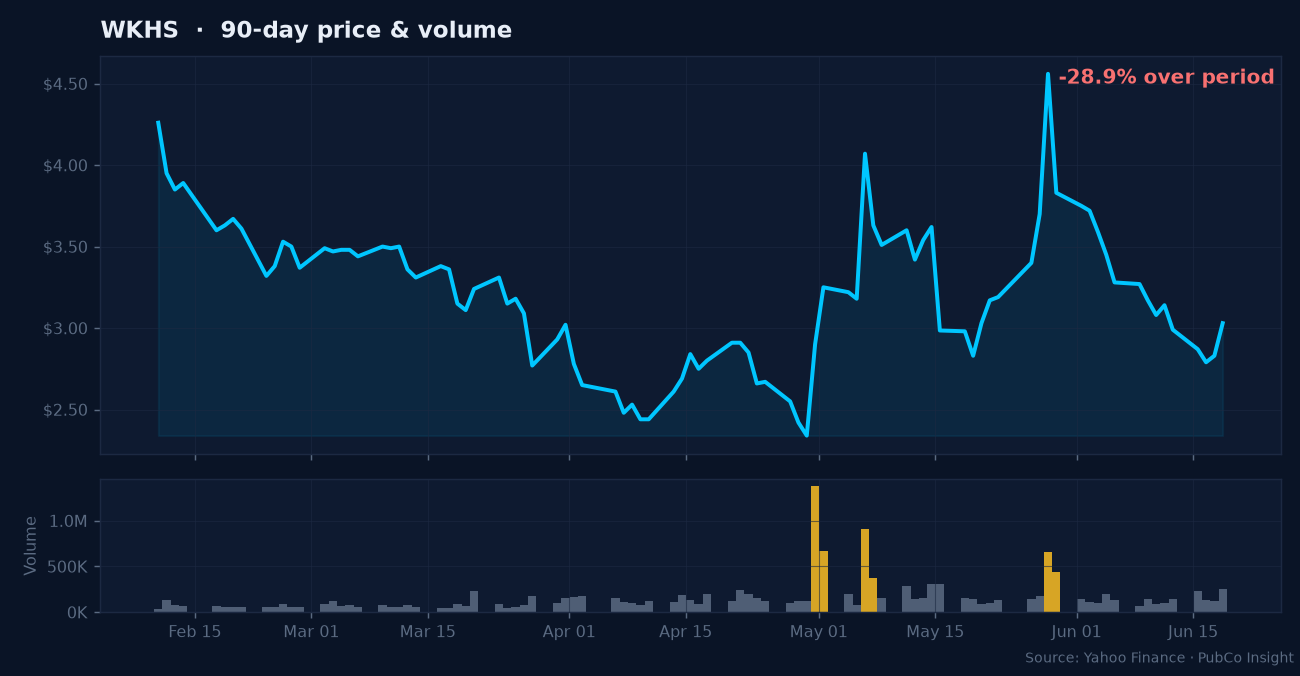
The mechanics became impossible to ignore in mid-August. Just twenty-four hours before filing its quarterly report on Form 10-Q and posting financial results under Item 2.02, Workhorse Group Inc. filed an 8-K disclosing items 1.01, 2.03, and 3.02. That combination means three specific things: a new material definitive agreement, the creation of a direct financial obligation, and an unregistered sale of equity securities. When a company issues unregistered shares while concurrently taking on direct financial commitments, common equity holders face immediate structural pressure.
This was not an isolated adjustment. The mid-August maneuver closely followed an earlier material agreement and debt creation event logged under Item 1.01 and Item 2.03 in June. When debt obligations and unlisted equity issuances start arriving in quick succession, capital structure priority shifts away from retail common stock. To evaluate how these repeated financings alter per-share claims, tracking dilution risk is essential for anyone holding shares through the cycle.
The timing creates a classic microcap pattern. An Item 7.01 operational disclosure in late July was quickly followed by fresh obligations in August, accompanied by an amended Schedule 13D and a Form 4 inside the same two-week window. Major stakeholders are actively adjusting their exposure while the business relies on private terms to keep operations funded. When financing arrangements require unregistered share issuances under Item 3.02, existing ownership bases inevitably absorb the impact.
Building commercial electric vehicles requires relentless amounts of cash, and the public records show WKHS continuing to finance itself through recurring bilateral agreements. Without massive self-sustaining operating margins, small-cap vehicle manufacturing remains tied to external balance-sheet interventions. Knowing what you own means recognizing that until operational cash flows replace Item 3.02 share sales, structural dilution remains a primary factor in the investment equation.
Primary sources (SEC EDGAR)
4 2026-08-25: https://www.sec.gov/Archives/edgar/data/1425287/000209739026000008/xslF345X06/wk-form4_1787693344.xmlSCHEDULE 13D/A 2026-08-25: https://www.sec.gov/Archives/edgar/data/1425287/000209739026000006/xslSCHEDULE_13D_X02/primary_doc.xml10-Q 2026-08-13: https://www.sec.gov/Archives/edgar/data/1425287/000162828026056708/wkhs-20260630.htm8-K 2026-08-13: https://www.sec.gov/Archives/edgar/data/1425287/000162828026056707/wkhs-20260813.htm8-K 2026-08-12: https://www.sec.gov/Archives/edgar/data/1425287/000162828026056273/wkhs-20260811.htm8-K 2026-07-28: https://www.sec.gov/Archives/edgar/data/1425287/000162828026049946/wkhs-20260728.htmSee the dilution and promotion flags before you see the pitch.
Each week: the micro and small-caps now showing dilution or paid-promotion signals, with the SEC filing behind every flag. No recommendations, no price targets.